
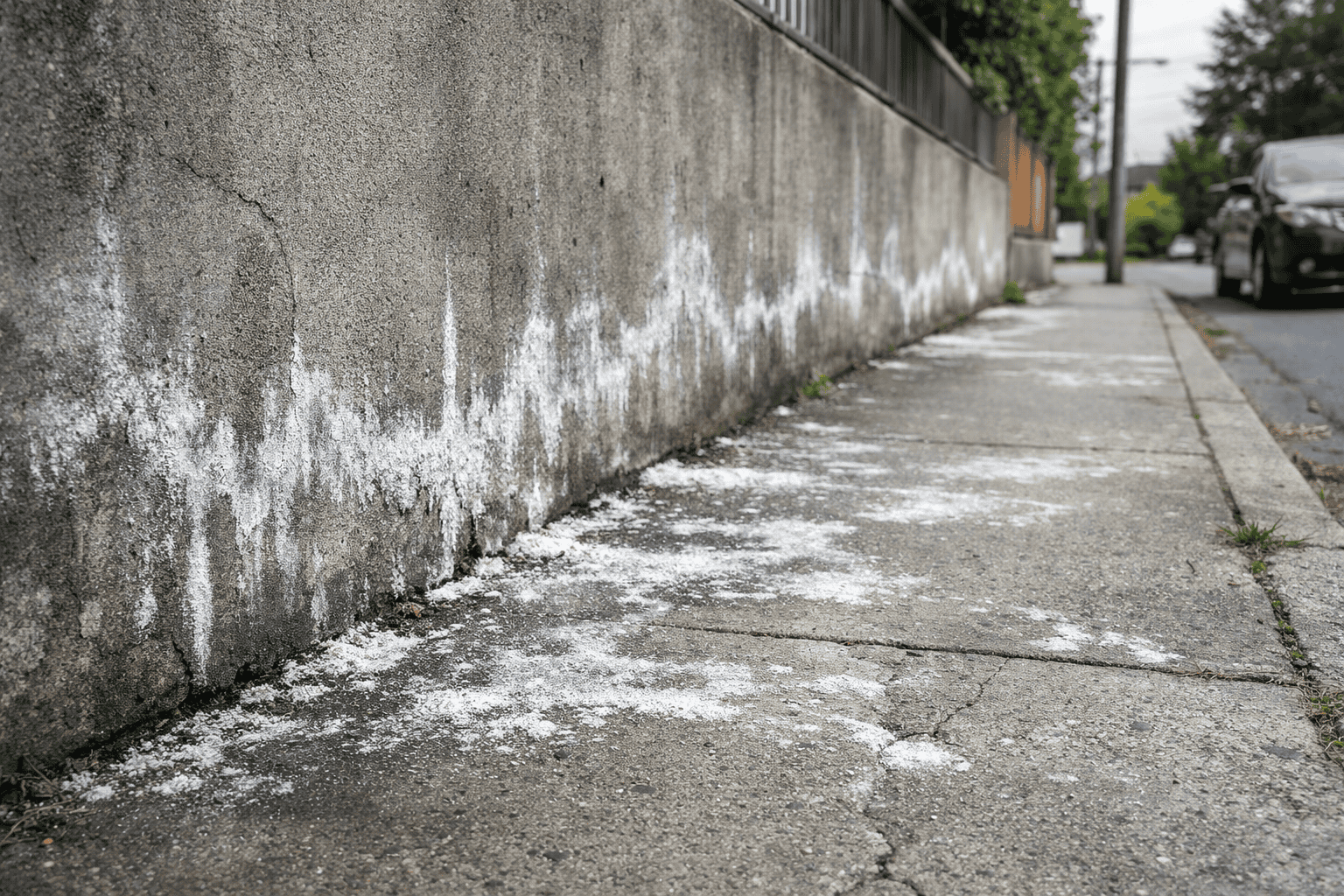
When specifying coating systems for concrete, masonry, or cementitious render, discussion often focuses on color and finish durability. Substrate chemistry receives less attention, yet it directly affects adhesion and service life. Fresh and curing cementitious materials remain highly alkaline; without a suitable alkali-resistant sealing primer, decorative or protective top coats may degrade early at the coating–substrate interface.
This article explains how alkalinity affects coating performance, common failure modes, and the role of alkali-resistant sealing primers such as Seal 902 before top coats such as Lycal 319.
Substrate Alkalinity and Coating Risk
Concrete, cement render, and masonry are chemically active materials. Fresh materials commonly show surface pH of about 12–13, due to calcium hydroxide formed during cement hydration. Even when the wall looks dry, residual moisture and alkaline salts can continue migrating to the surface during curing.

From Ca(OH)₂ to CaCO₃: Hydration and Carbonation
When cement is mixed with water, hydration occurs. The main calcium silicate phases (C₃S and C₂S) form calcium silicate hydrate (C-S-H)—the binder that provides strength—and calcium hydroxide (Ca(OH)₂, also called portlandite) as a crystalline by-product. Dissolved Ca(OH)₂ keeps the pore solution highly alkaline, typically around pH 12.5–13.5. In hydrated cement paste, portlandite usually accounts for a substantial share of hydration products, so alkalinity is inherent to the substrate—not a short-lived surface residue.
Over time, atmospheric carbon dioxide (CO₂) enters the porous cement paste, dissolves in pore moisture, and reacts with calcium hydroxide to form calcium carbonate (CaCO₃, mainly as calcite) and water:
Ca(OH)₂ + CO₂ → CaCO₃ + H₂O
This carbonation reaction consumes hydroxide ions and gradually lowers near-surface pH; in fully carbonated zones, pH often falls to about 8–9. Carbonation advances from the outside inward; its rate depends on porosity and humidity and is usually slow under normal service conditions. Therefore, 28 days of structural curing does not mean the coating interface is chemically neutral. At the time of coating, residual Ca(OH)₂ and migrating alkaline salts are often still active.
If a conventional emulsion or oil-based top coat is applied directly in a highly alkaline environment, alkali attack can damage the binder system. A typical pathway is saponification: alkali reacts with binders to form soap-like residues, weakening film cohesion and interfacial adhesion. The result is reduced adhesion, early peeling, and shorter coating life.
An alkali-resistant primer does not convert bulk substrate Ca(OH)₂ into CaCO₃. The purpose of specifying an alkali-resistant sealing primer is to seal and isolate the top coat from the alkaline interface, and to stabilize the substrate before top-coat application.
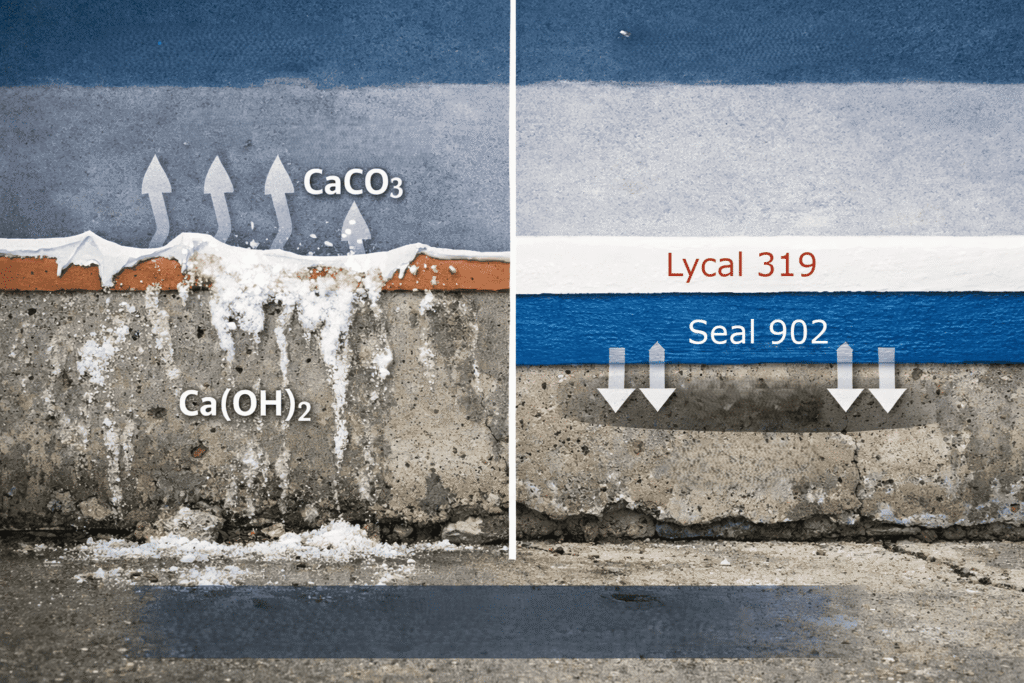
New Concrete vs Carbonated Concrete: How to Treat Them
Alkalinity risk on cementitious substrates differs between “new” and “already carbonated” conditions. Both may still need primer, but surface-preparation priorities are not the same.
1. New concrete / fresh render (Ca(OH)₂-dominant)
After hydration, new concrete still contains large amounts of calcium hydroxide, with surface pH often around 12–13. Even after 28 days of curing, the coating interface often remains highly alkaline; carbonation has not advanced deeply, and CaCO₃ formation is limited.
Treatment points:
- Confirm structural curing is adequate, and check whether surface moisture and strength are suitable for coating
- Remove dust, release agents, and loose material
- After repairing cracks and defects, apply an alkali-resistant sealing primer first (e.g. Seal 902)
- After the primer has dried/cured, apply a compatible top coat (e.g. Lycal 319)
The main goal at this stage is to isolate the highly alkaline interface and reduce risks of saponification, poor adhesion, and early peeling.
2. Concrete that already contains CaCO₃ (carbonated surface)
On long-exposed concrete, near-surface Ca(OH)₂ may already have converted partly to CaCO₃ through carbonation, and local pH may fall to about 8–9. Near-surface alkalinity is relatively lower, but that does not mean primer can simply be omitted.
Reasons include:
- The carbonated layer is often thin; the interior may still remain highly alkaline
- Uneven pore suction, salt migration, dampness, and contamination can still affect the top coat
- Old surfaces often have chalking, dirt, old coatings, or residual efflorescence
Treatment points:
- Assess surface condition: chalking, hollowness, old paint, efflorescence, dampness
- Clean thoroughly; abrade or pressure-wash if needed, then allow the surface to dry
- On porous or unevenly absorbent surfaces, a sealing / alkali-resistant sealing primer is still recommended to equalize suction
- If local high alkalinity remains (e.g. fresh cement patches, recurring efflorescence), treat those areas as new surfaces and strengthen alkali-resistant priming
3. Quick comparison
| Condition | Chemical profile | Main risks | Recommended approach |
|---|---|---|---|
| New concrete | High Ca(OH)₂; pH ~12–13 | Saponification, adhesion failure | Clean + alkali-resistant sealing primer + top coat |
| Carbonated concrete | Near-surface CaCO₃; lower pH | Uneven suction, contamination, residual alkalinity | Clean and assess + sealing / alkali-resistant sealing primer (as needed) + top coat |
| Local cement repairs | Local return to high alkalinity | Local saponification, color variation, delamination | Treat those areas as new; do not skip primer |
4. Specification guidance
Whether new or already carbonated, the coating system should be based on substrate condition, not curing days alone or whether the surface looks white/dry. An alkali-resistant sealing primer seals and isolates; it does not convert all Ca(OH)₂ in the concrete into CaCO₃. For a Seal 902 + Lycal 319 system, the key sequence is: confirm the substrate is clean, sound, and dry; stabilize the interface with a compatible primer; then apply the top coat.
Common Failure Modes When Primer Is Inadequate
Omitting or under-specifying primer on highly alkaline masonry increases related failure risks:
- Saponification / alkali attack — High pH can degrade sensitive binders, softening the film and reducing adhesion.
- Efflorescence (white bloom) — Moisture carries soluble salts to the surface, forming white crystalline deposits that spoil appearance and may lift the coating.
- Blistering — Water vapor and soluble salts create pressure under a low-permeability film, forming bubbles or local delamination.
- Uneven suction — Porous concrete absorbs vehicle from the top coat irregularly, causing flash drying, roller marks, and uneven color/sheen.
These mechanisms are substrate-driven. Surface cleaning alone cannot remove the chemical risk of high alkalinity.
Function of an Alkali-Resistant Sealing Primer
An alkali-resistant sealing primer is an interface layer. Its main roles include:
- Limiting contact between alkaline salts in the substrate and top-coat binders
- Penetrating and sealing open pores to regulate suction
- Improving adhesion conditions for subsequent coats
- Providing a more uniform base for color and film thickness
Unlike a filler coat that only closes visible texture, a properly formulated alkali-resistant sealing primer addresses both chemical exposure and suction control on masonry surfaces.
Seal 902 as an Alkali-Resistant Sealing Primer
Seal 902 is an acrylic alkali-resistant sealing primer formulated from selected acrylic polymer emulsion and additives. It is suitable for substrates such as concrete, brick, cement render, plaster, and stone—especially where high alkalinity, porosity, or uneven suction may affect top-coat performance.
In a coating system, Seal 902 as a preparatory layer can:
- Provide alkali-resistant priming at the substrate interface
- Penetrate porous surfaces and help seal irregular suction
- Improve adhesion between the masonry base and the top coat
- Offer a degree of waterproofing as part of surface preparation
Before application, the substrate should be clean, sound, and dry, free of dust, laitance, oil, grease, and loose material. Weak or peeling areas should be removed first, and surface defects repaired beforehand.
System Use with Lycal 319
High-performance acrylic top coats such as Lycal 319 depend on a stable substrate. If a durable top coat is applied over untreated highly alkaline substrate, coating performance is limited by the interface, not by the top-coat chemistry alone.
Seal 902 is suitable as the alkali-resistant sealing primer before Lycal 319. In this system:
- Seal 902 primes and seals the masonry surface
- Lycal 319 provides the decorative or protective top coat
Always verify compatibility, substrate preparation, and curing/drying intervals against both products’ technical data sheets.
Conclusion
Concrete and masonry remain alkaline for a long time after setting. An alkali-resistant sealing primer addresses this by sealing pores, limiting alkali attack at the coating interface, and improving adhesion before top-coat application. Seal 902 is designed as a preparatory layer for concrete and masonry substrates; once system compatibility is confirmed, it can be specified before durable acrylic top coats such as Lycal 319.
Correct priming cannot replace surface preparation, but it is a necessary control layer for coating durability on highly alkaline cementitious substrates.
FAQ
Is primer still needed after 28 days of concrete curing?
Yes, if coating durability is required. A 28-day cure means hydration has reached a minimum stage, but the surface is often still highly alkaline and may retain moisture. An alkali-resistant sealing primer is used to manage interface risk.
Does an alkali-resistant sealing primer neutralize concrete pH?
Generally no. Products such as Seal 902 seal and isolate the highly alkaline substrate from the top coat; they do not permanently neutralize bulk concrete alkalinity.
Do carbonated old concrete surfaces still need an alkali-resistant sealing primer?
Near-surface CaCO₃ may already have formed and pH may be lower, but primer should not be omitted by default. The carbonated layer is often shallow, and the interior may still be highly alkaline; old surfaces also often have chalking, contamination, or uneven suction. Assess cleaning and substrate condition first; on porous or unstable surfaces, a sealing / alkali-resistant sealing primer is still recommended.
After local cement repairs, must the entire surface be reprimed?
Fresh cement patches return to a highly alkaline state and should be treated as new concrete with strengthened alkali-resistant priming. Remaining sound, previously treated areas can be assessed case by case for full repriming. The key is to avoid applying top coat directly over new patches, which can cause local saponification, color variation, or delamination.